
18.03.2026
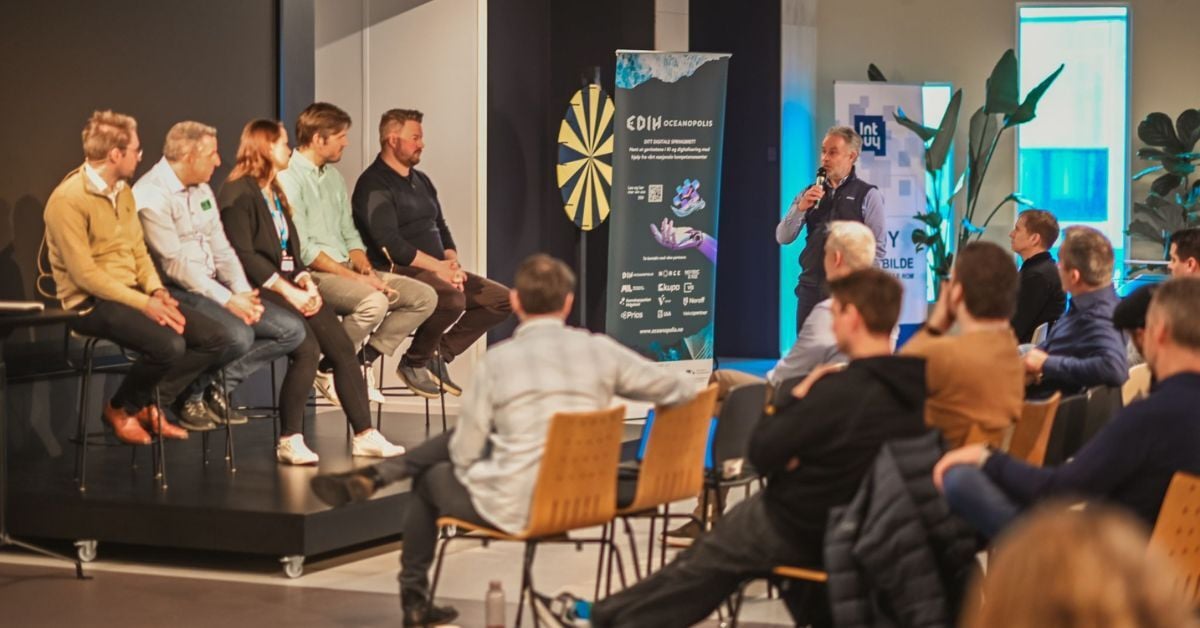
Reflections from the EDIH Oceanopolis panel debate
By
Dagfinn Solvik-Olsen, Head of Field Survey, Field Geospatial
The construction and civil engineering industry is currently undergoing a technological shift that is far more fundamental than a typical system upgrade. At the industry event “AI, laser scanning and robotics on the construction site” at EDIH Oceanopolis, Field Geospatial had the opportunity to participate in panel discussions on how these trends are shaping the industry.
In this article, we share our reflections from the event and highlight some key trends:
1. Automation is moving out of theory—and onto the construction site
Where we previously spoke about robotics as a future scenario, we now see practical, mature solutions that actively support workers, reduce errors, and improve productivity. A good example is the HP SitePrint robot, which we at Field Geospatial have implemented in several projects.
Robots are now used for more than simple line marking. They are part of an integrated planning process where:
- Drawings are translated directly into precise positioning on site
- Production teams achieve consistency and highly repeatable accuracy
- Errors are reduced before they impact concrete, steel, and prefabricated elements
The maturity of this technology is not just about the robots themselves, but about the surrounding ecosystem—data flow, models, expertise, and standardization.
2. Laser scanning and digital twins are becoming standard—not an add-on service
Both in the panel and among participants, there was broad agreement:
3D data capture is becoming an expected foundation in all projects.
This applies whether using:
- NavVis VLX for complex indoor environments
- MMS platforms for infrastructure projects
- Drone LiDAR and photogrammetry for larger terrains and structures
- Stationary scanners where precision and detail are critical
The discussion is no longer about why to scan, but about how to ensure data quality and how to integrate data efficiently into BIM and GIS processes.
The most important factor is not the scanner itself, but how these practices become a natural part of the project’s quality system—from design through to as-built documentation.
3. AI is changing how we work with data and decisions
AI was naturally a central theme throughout the event. The greatest value lies not in flashy algorithms, but in:
- Automated quality control of models
- Rapid deviation detection between planned and executed work
- Predictive analysis related to risk and progress
- Intelligent filtering of large point clouds and model datasets
- Automated reporting and documentation
We are already seeing how the combination of AI, laser scanning, and robotics removes manual and time-consuming processes—and frees up time for professional judgment, collaboration, and quality assurance.
4. Integration between field and office is the key to value
One of the most important takeaways is that technology only creates value when data flows are fully connected.
When field operators, design teams, construction sites, and control functions use the same data foundation, the same models, and consistently updated versions, the following improve:
- Accuracy
- Speed
- Quality
- Predictability
This requires standardization, strong processes—and not least, investment in competence and skills. There was broad agreement in the panel that the industry must invest just as much in people as in technology.
What does this mean for Field Geospatial and the industry going forward?
Based on the discussions, three clear directions stand out:
- Automation of fieldwork will accelerate—robotics and AI will become an integrated part of everyday operations
- 3D data will become the standard for documentation—not an add-on
- Data quality and data flow will become the key competitive advantage—those who master seamless integration between field and office will succeed
For Field Geospatial, this is at the core of what we do every day. We combine technology, experience, and data-driven workflows to deliver precise measurement, efficient production, and reliable decision support.
Feel free to get in touch if you would like to discuss these topics further.